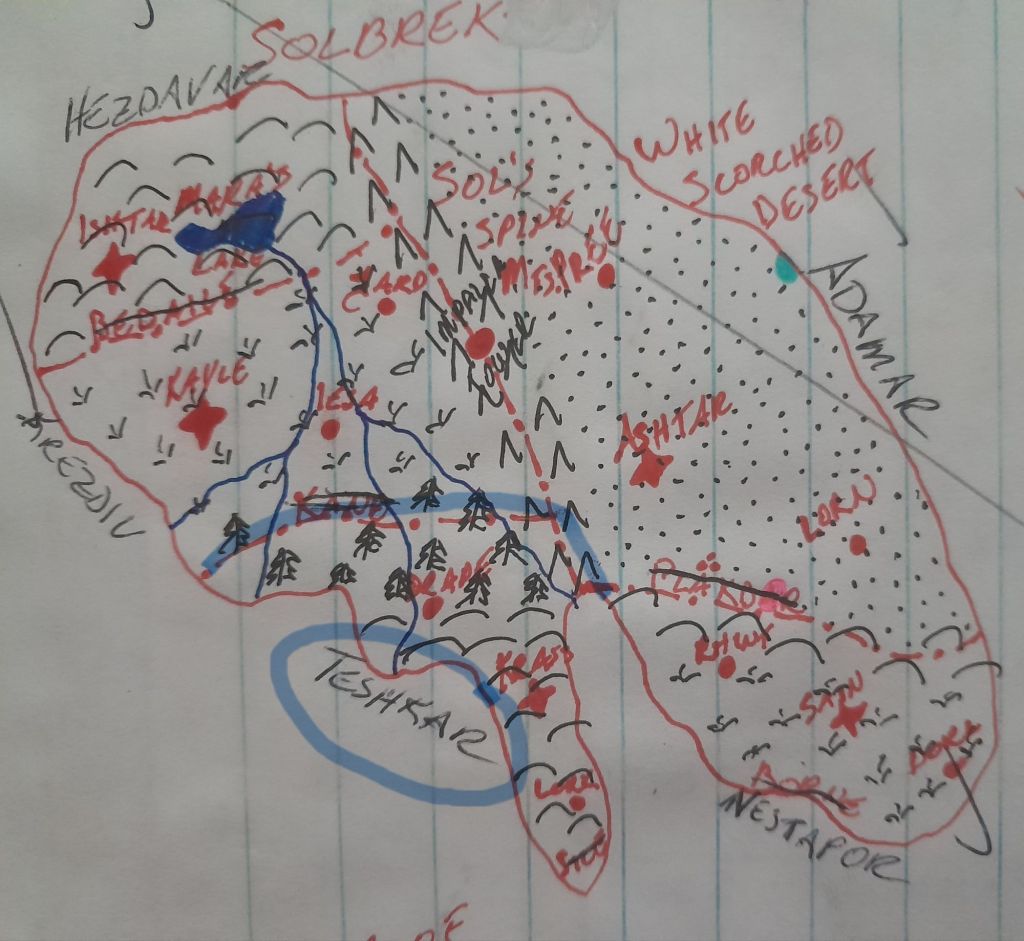
is a matriarchal society that is often overlooked or looked down upon. They have no real navy, but a strong army and cavalry. It is a country of mostly hills and forests with only a little farmland along the three rivers that cut through its terrain. Teshkar could be considered a Spanish-like culture. It is a relatively self-sufficient society and often misunderstood or simply neglected by the neighboring countries.
Maas Zupkas of Iskenderun is the only regular entity the queendom of Teshkar trades with. Their relationship dates back several decades and therefore affords Iskenderun, and more specifically the capital city of Debash free access to rare and exotic items not found anywhere else on Terra. It is a little-known fact, even to his son Varkas, that the late Lady Zupkas was a Teshkaran noblewoman. As a result, Teshkar has access to many commodities from Iskenderun they would otherwise not even be aware of.
Despite all this, the distrust of most other nations, the self-sufficiency, and the strong ground military, Teshkar is a nation that loves, admires, and appreciates the arts. All citizens are required to serve a minimum of three years in the Teshkaran military. Many stay and make it a career, while many others seek out different professions. While not known throughout Terra, smiths of every kind are incredibly skilled. Farmers and herders are capable of defending their homes and lands. The capital is not a large city, by the standards of most other nations, but is considered well-developed.
Slavery is legal but uncommon. The capital is the only large city, by national standard. Villages look out for one another and trade readily and frequently. Many children receive their education at home, rather than in a formal school setting, though they do exist. Beyond basic reading, writing, and math, children learn in common as well. Most are introduced to a trade before joining the military.
Marriage and divorce are both normal and socially acceptable. While men have nearly equal rights, it is usually the woman who decides how children are raised, how finances are handled, and who will lead in the village. Women often select their mates, rather than the other way around. They also, regularly, end the relationships as well. Women have the final say on legal matters.
 The World of Terra