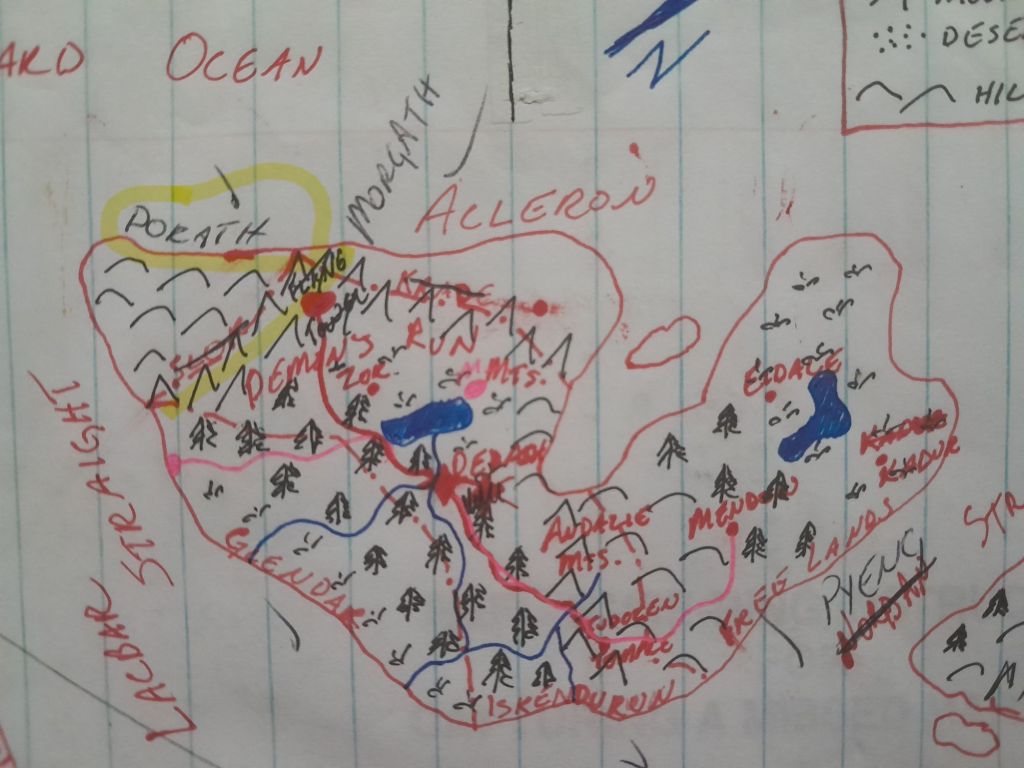
Dorath

home of the dwarves is a land of mountains and hills. While they sustain some farming (mostly growing grain and raising meat animals) to provide for the population with little trade needed, they focus much of their time and effort into fermenting beverages, mining ores and gems, crafting incredible items from their mining, and no small amount of creative engineering.

These sturdy and industrious beings garb themselves in natural fibers, often adorned with additions of metals or gemstones. When in battle they regularly wear full or partial plate mail, or scale mail. Their favored weapons are often the tools they work with, though double-headed axes are regularly weilded too. The war machines they design and create are unequalled in all Terra.

Dwarven weapons and armor are unequalled in all Terra. Their techniques are closely guarded secrets, passed down from one generation to the next. The same is true of their jewelry, war engines, and other inventions.

It is said that Amon, creator-god of dwarves, raised up the mountains so they could learn, study, and perfect their skills. He is believed to have whispered the greatest secrets of smithing into the stones and they sprang to life as Xenon Hammerfell and his blushing bride Onyx Clangadin. Upon their appearance, Amon charged them to multiply and teach their children the secrets he taught them.

As the mountain halls filled, the massive dwarf-built, underground cities got crowded. Tempers flared, resentment festered. The children of Xenon and Onyx left, to explore their world and establish trade with the other races. As they did, they intermingled bloodlines, ideas, and cultures. This brought more wealth and renown to the dwarf kingdom.

As the centuries passed, the men of Terra tried to steal the knowledge and resources of Dorath. This led to tension and ultimately war among the races. While victorious in defending their secrets, the dwarves withdrew into their kingdom and only traded sparingly with the neighboring countries.

The Free Lands

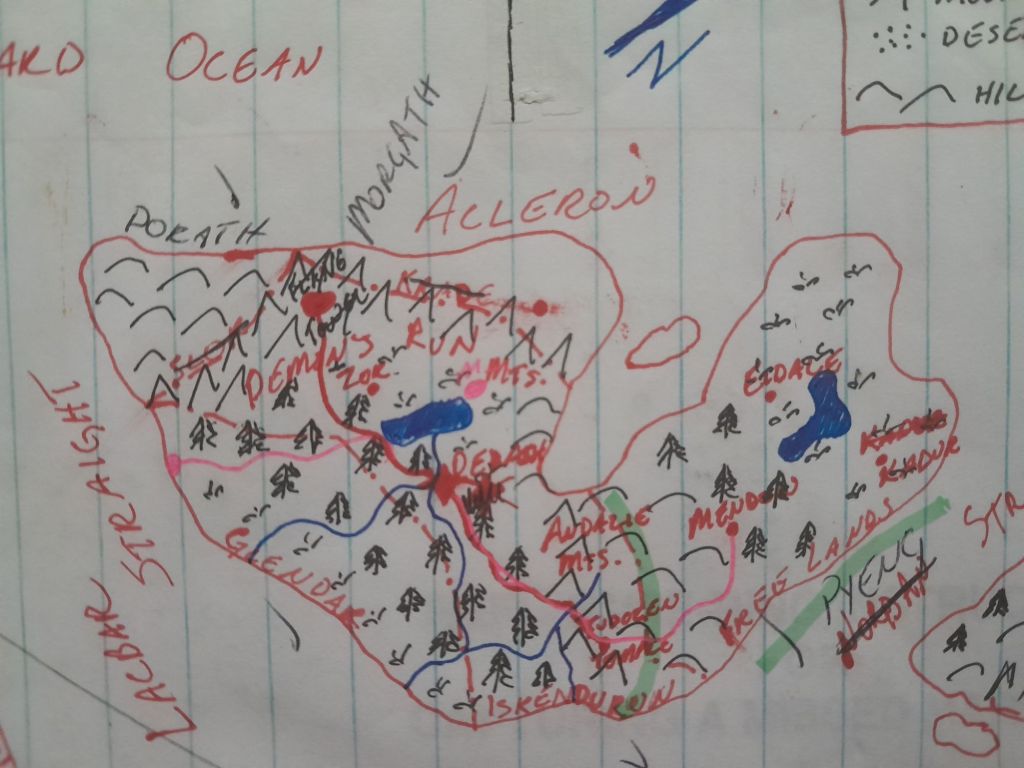
home of the Vahkahran, the wild and nomadic tribes similar to Mongolians, and the independent city-states. This land is mentioned briefly in the first book but is truly introduced in the second.

Mostly grasslands, but with a few rolling foothills leading into the Andalie Mountains, and a small forest along the northwestern coast, it boasts the greatest herds of sheep and goats in Terra. The Vahkahran, mighty warriors to the last, are fiber artists without equal. The independent city-states boast some of the greatest jewelers outside the Dwarven kingdom, and skilled farmers who grow produce found nowhere else in Terra. Lastly, the White Cliffs are renowned for their weaponsmiths and armorers, second only to the dwarves.

Only a handful of merchants risk the journey. As a result, there is a sort of monopoly on the goods entering and leaving Iskenderun.

In the beginning, the Vahkahran were a single massive tribe called Neera. It was led by a great chief who had seven brave and skilled sons. Chief Ashahkar ruled Neera with an iron but steady hand. He and his shaman established the majority of the laws and traditions that are still honored and/or held to at present day. However, upon his death, the tribe was divided into seven smaller tribes, as his sons couldn’t abide by his decision of who would be his successor.

Historicly, the country has been left to its own devices.

Slavery is still legal. The strongest survive and thrive, as they have since the beginning.

*Spoiler Alert*

This is the time of both the greatest peace and the most turmoil since Neera first rode the plains. Under Chieftess Kaylin Zel, the whole of the country is united in preparation. The future is uncertain, but they all desire to defend their home.

Glendar

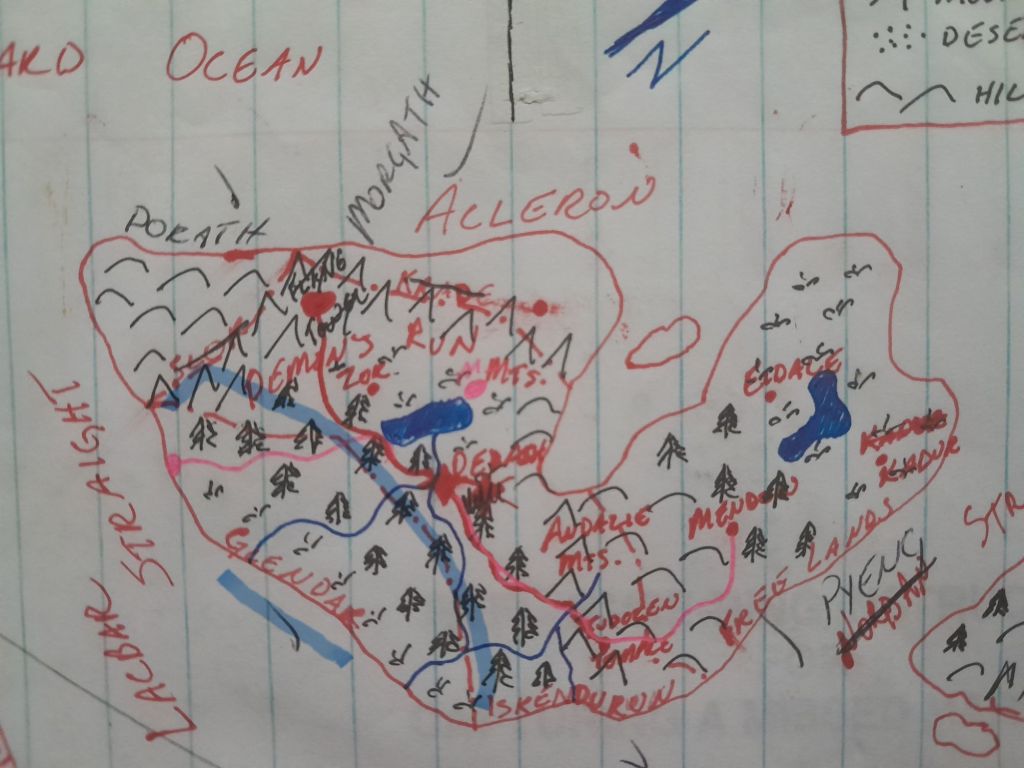
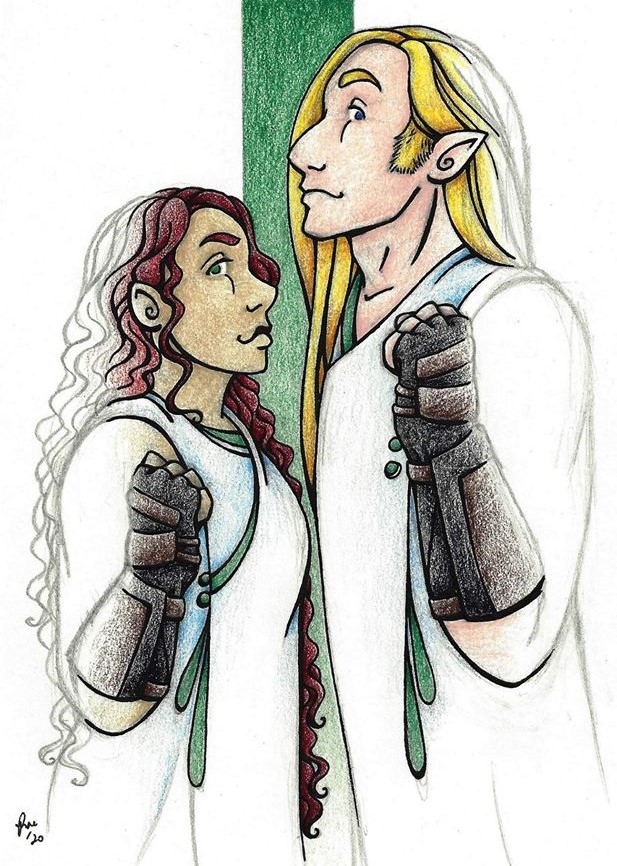
home of the elves, where the entire series begins. It is the largest and most ancient forest in all Terra. While there is some grassland near the coast and occasional clearings scattered throughout, it is the forest home to both high and wild elves. This is the place many refer to when they speak of the Great Forest.

The elven nation makes up nearly ninety percent of the southern border of Iskenderun, while only a small portion if its western border is shared with the dwarven nation along the southern run of the Demon’s Run Mountains. This is where many elven princes have served for decades in the Titans’ Guard before returning to the palace to learn to rule the nation.

While most mock the elves and often refer to them as sprites, faeries, or other such unflattering terms, most are skilled warriors, trained for nearly a half century before allowed to join the elven army. Longbow and either a single long sword, or combination of long and short sword, are the prefered weapons of these lithe and lethal fighters. Still, many chose to atune themselves more keenly with the land. As a result, they are revered as rangers or druid who guard and defend the natural world.

For generations beyond remembering, the elven monarchy was led by the first pureblood son of the reigning elf king. Only when King Darlyn Zephyr took the throne and named his first born, bastard, son prince of the blood, did things begin to change. That is what sparks the civil war that opens the series.

Elves are seldom inclined toward elaborate and ornate attire. Most tend to wear simple, natural, and effective garb in browns and greens. Only for the most special of occasions do they adorn themselves with any sort of jewelry.

While they celebrate the winter and summer solstice, and the fall and spring equinox, the elves also rever every other celestial event. They can often be found dancing beneath the moon and stars on the nights of meteor showers and full moons, as well as when significant constelations apear. Elves rever the stars as their great memory-keepers.

*Spoiler Alert*

Once home to hundreds of colonies of faeries and fae kind, the ignorance of humans saw their numbers vastly depleted. Thanks, however, to King Tarak Zephyr and his rescue of the faerie queen in his youth, they have begun to flourish once again. It will take, at the least, the span of an elven generation to return to the vastness of ancient times, but things look bright for the elfkin.

Cynsely

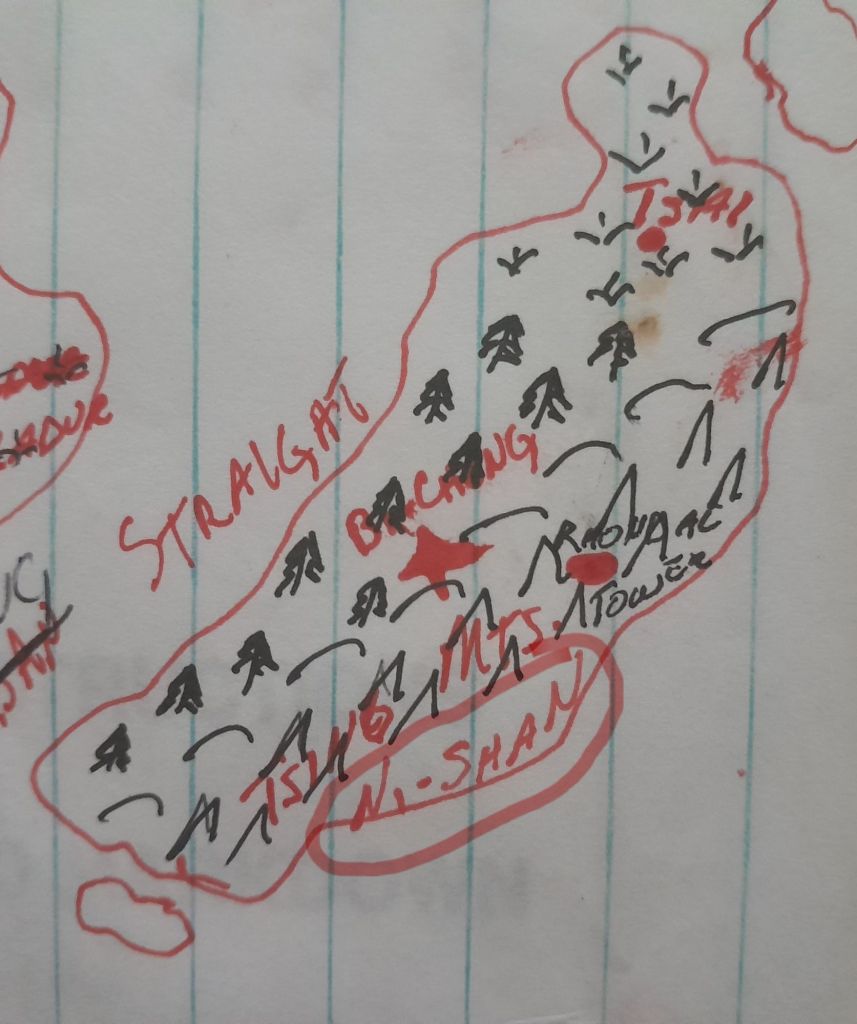
is the island nation where the rest of Terra comes to learn more about medicine. They are the only true democracy. While not the most magically advanced, they are a beacon for learning, a leader in civil engineering, and the home of the greatest shipwrights known through all the world.

Waxing Moon Cove is the home of the most renown shipwrights in all Terra. They built most of the ships in the Iskenderian Royal Navy. They also built many of Maas Zupkas’ ships for his massive trade conglomerate.

As the country is vastly covered in forests, this facilitates the shipbuilding enterprise. It also allows them to export the lumber to the other countries throughout Terra. They boast some of the most rare and exotic woods, as well. Meanwhile, the remainder of the country is open fields of buckwheat, barley, and oats. There are smaller fields of corn, orchards, and farms with cows, pigs, and chickens. Fist, crustaceans, and shellfish are plentiful for the island nation and they export a portion of their catch.

The medical academy resides in the capital. It is the benchmark for healthcare and medical knowledge throughout Terra. Priests, clerics, midwives, and healers aspire to study there. The most modern techniques are studied and taught.

There are rumors, currently unfounded, of ancient creatures residing in the hills surrounding th cove. However, nothing has ever been proven. Some say an ancient druid resides on the edge of the hills, in the forest. Some say more rare and exotic beings reside there.

It is the home of modern plumbing. The founder of the sciences, which is a new field of study that few are aware of. It is also trying to encourage more countries toward democracy, rather than kingdoms. They are struggling to establish a foot-hold.

Kardash

was once the domain of a powerful witch. It is heavily populated with goblins and kobolds. The residents of the country are too busy trying to stay alive to concern themselves with little more than basic farming and hunting. There is no exporting and little importing. Some trade goes on between villages, but each small hamlet is relatively self-sufficient.

From a young age those who live in Kardash learn to fight and defend themselves. As a result, most either die young or become unparalleled warriors. They are skilled with bow and blade.

Due to the ravages of the monster kind, there is no capital city. The citizens govern themselves with local magistrates, mayors, and militias. Despite the hardships, the population is on the rise and the monsters are slowly being brought to heel.

Surrounded on three sides by water, the seaside villages have swelled to the size of towns and even small cities. They are able to defend better and support the population. Sometimes they trade with the villages in the forest, seafood for venison.

It is considered the least developed country in all Terra, in most respects.

Nordan

is the second largest exporter of lumber in all Terra. Aside from the Duran Hills and Arising Lake, the country is covered in both deciduous and coniferous trees. At one point in its distant past, the country had an entire forest of wandering willows that were cut down and used to build the temple to Lucian in the capital city of Lerball. It is the most grand and glorious temple to the god of Justice, and a pilgrimage site for the most devout followers. This brings the greatest revenue source to the country.

The country, a strongly Slavic-influenced culture, farms grains, cattle, and fruit trees. It also exports the exotic devora herring and fresh-water muscles from the Arising Lake. It heavily exports the rushing salmon that populate the upper expanses of the rivers.

The king and queen, who reside in separate palaces on opposite sides of Arising Lake, are often at war over who controls the country. Each has multiple lovers and bastard children, but no legitimate heirs with each other. As a result, the future of the country is always in question. This country’s intermittent civil war and persistent unrest makes it the second favorite country of the Shadow Council, as they often aide the side who pays better.

Despite the faithful journeying to the capital, the country is wholly unstable and rife with danger for its citizens. Local militias are the only way the inhabitants are able to defend themselves.

Rhoan

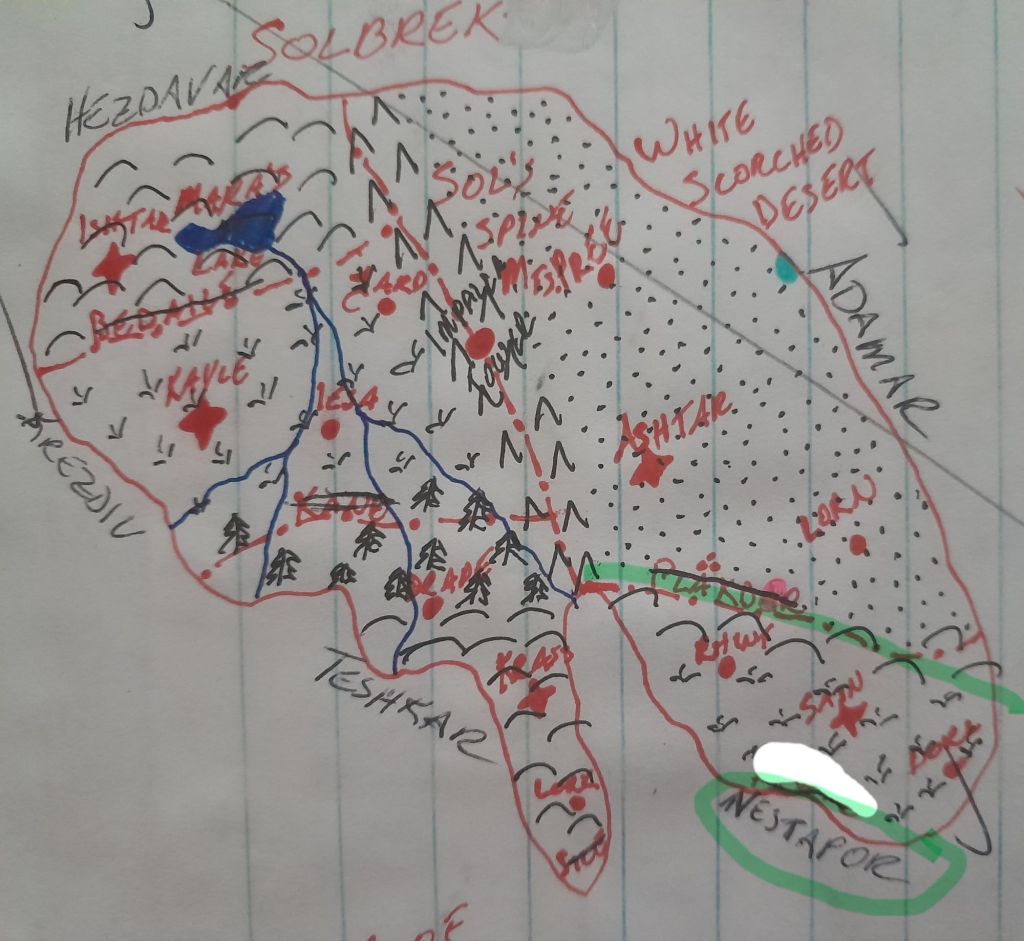
is the largest exporter of adamantine in all Terra. Most of those who reside along the western coast within the Cresting Hills and Twin peaks on the Tartan Peninsula work the mines that produce the exotic mineral. Across the Sundering Bay in the Dancing Hills are the most productive diamond, emerald, ruby, and sapphire mines in all Terra.

The northern and western branches of the Tetra River run through the southern part of the country providing a fair amount of freshwater fish. Naturally, the coastal region is flush with saltwater life providing sustenance and trade for those skilled enough to take advantage. Meanwhile, the Lancar and Brax Rivers offer different varieties of freshwater fish from the southern river. At the head of the bay, are gold, silver, and copper mines that are mostly exported.

The land around the rivers is lush and fertile, making for excellent farming of all kinds. The forests along the Cresting Hills is full of wild game. As a result, the country is relatively self-sustained. Their gem and mineral export makes them the wealthiest country. However, it has been in the midst of a civil war for many generations. The current rulers are at war with the heirs of the previous rulers. This has led to economic instability.

Quite frequently, the Shadow Council can be seen fighting for one side or the other. As a powerful mercenary band, they make most of their money off this conflict.

Alondrol

home of Princess Anya Sophia Kofski, heavily influenced by Russian culture. It is a large country and vastly grasslands and forest with the Shadow Mountains on its northeastern border with Nordan. The Trident River flows out from Shimmergloom Lake, providing access to the exotic and rare titan-head trout, which is found solely in its dark and sparkling, purple-blue waters. Between the fish and the unusual aquatic plant life the lake acquired its name.

Islith Valley, located between Tilda Forest and Shadow Mountains, is home to an extremely skilled and secretive clan of warriors. It is also the home to the most sought-after hot springs on Fraylon. One cannot enter the Valley without first challenging, and defeating, its champion in single combat.

At the eastern-most corner of the country, is the once-most-fertile farmlands in all Terra. However, because the expanse is shared by the three largest countries on the continent, it was ultimately trampled to ruin.

The grasslands and southwestern hills are home to the farmlands that provide enough food for the country to allow them to export a significant amount of the crops every year. Not only are there cow, sheep, and pig farms, but alpacas are also a significant staple. Orchards and grains provide the remainder of the crops in the west while produce and cocoa are the staples of the east. The coastal fishing and deep diving provide a wide variety of fresh seafood for its own use as well as export.

While not home to any prominent schools of education, its citizens are intelligent and well-informed. Its military is more heavily infantry with light cavalry and their navy is a fraction of the size of Iskenderun’s or Nestapor’s. As for its information network, it still needs a significant amount of work before it will rival even Krezdiv’s.

Hezdavar

is a Turkish-like culture in a hilly country with a vast lake which is the main source of their export since the aquatic life is unlike anything else in all Terra. The hill-country is also conducive to raising powerful and skilled horses and war elephants. While it’s not probable to export the war elephants overseas, it is possible to export them to anywhere on Solbrek. The war elephants have not been in high demand of late, though Teshkar acquired nearly a hundred of the beasts during their near civil war nearly two decades prior to the start of the series.

This country prizes beauty, grace, and strength above all else. Their nobility are almost exclusively housed in the capital city of Ishtar. Only a few live in sprawling and expansive compounds surrounding Lake Izarashi. None live out in the countryside. Incest is not uncommon among the nobility, to “keep the bloodlines pure” and also to maintain a specific level of beauty and desirability.

The singularly unique hammer-head salmon reside only in Lake Izarashi. Commonly used for scrimshaw as well as its buttery-sweet flesh, this is the biggest export product in the country. The northern corner of the country is renown for its exotic and rare spices. The combination of winds from the ocean and mountains, added to the fertile soil is ideal for the other famous income of the country. Between the fish, spices, and the breeding stallions, the nobles continue to assert their power. Slavery is also legal, acceptable, and a regular occurrence throughout the kingdom. Farming of all kinds provides the kingdom with nearly all the sustenance for the inhabitants. Fishing, within the lake as well as on the ocean, provides for the people as well.

While there are no academies or Titans’ Guard citadels, Hezdavar puts out many of Terra’s great warriors and mages who participate in the Corelon Zepheroth. Not to mention, the palace guards are among the most feared in Terra. They spend their lives, from age five, learning combat in all its myriad forms. Nearly all the royal guards are nobility in one form or another.

Two of the spices grown are also used for dyes. One creates a stunning yellow-orange while the other creates a unique bluish-purple. They are most often used to dye silks and pure cottons. These can be exported on their own as raw products, as well as in any stage of the product. They are the second largest export for the country and closely regulated by the nobility because they consider the colors exclusive for the extremely wealthy.

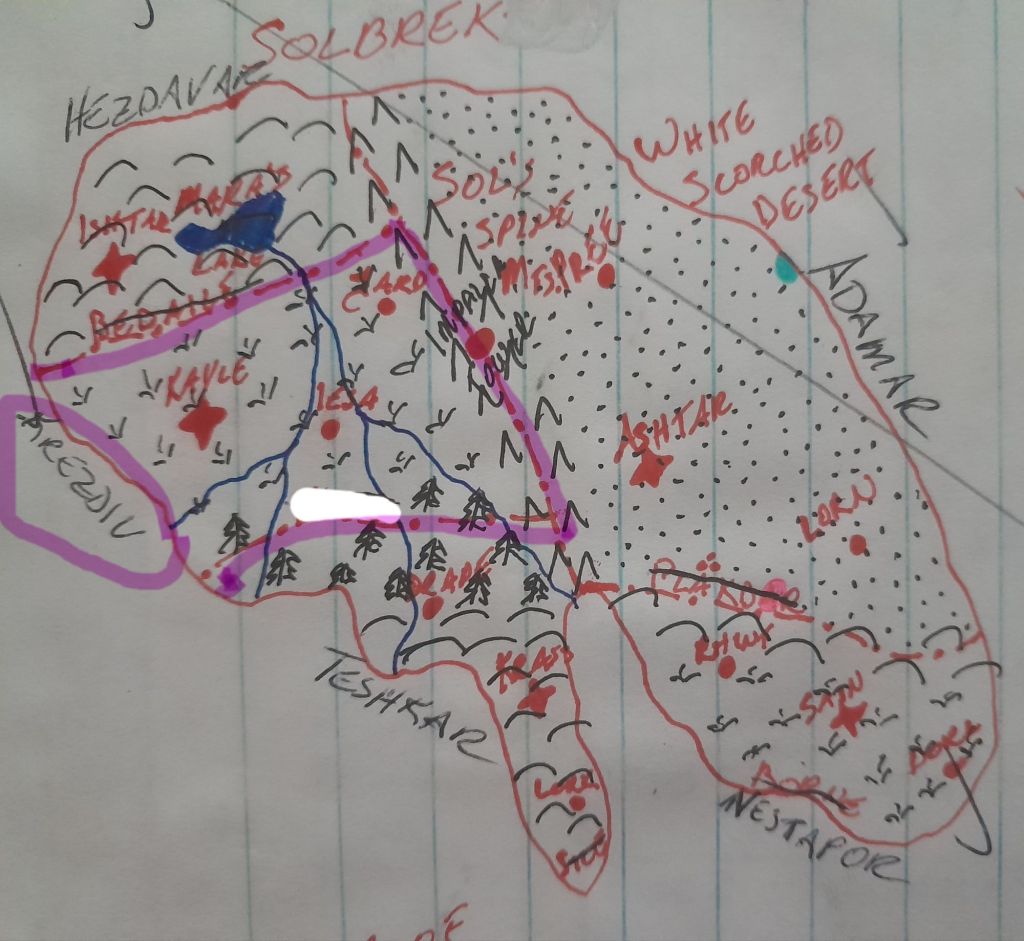
Teshkar

is a matriarchal society that is often overlooked or looked down upon. They have no real navy, but a strong army and cavalry. It is a country of mostly hills and forests with only a little farmland along the three rivers that cut through its terrain. Teshkar could be considered a Spanish-like culture. It is a relatively self-sufficient society and often misunderstood or simply neglected by the neighboring countries.

Maas Zupkas of Iskenderun is the only regular entity the queendom of Teshkar trades with. Their relationship dates back several decades and therefore affords Iskenderun, and more specifically the capital city of Debash free access to rare and exotic items not found anywhere else on Terra. It is a little-known fact, even to his son Varkas, that the late Lady Zupkas was a Teshkaran noblewoman. As a result, Teshkar has access to many commodities from Iskenderun they would otherwise not even be aware of.

Despite all this, the distrust of most other nations, the self-sufficiency, and the strong ground military, Teshkar is a nation that loves, admires, and appreciates the arts. All citizens are required to serve a minimum of three years in the Teshkaran military. Many stay and make it a career, while many others seek out different professions. While not known throughout Terra, smiths of every kind are incredibly skilled. Farmers and herders are capable of defending their homes and lands. The capital is not a large city, by the standards of most other nations, but is considered well-developed.

Slavery is legal but uncommon. The capital is the only large city, by national standard. Villages look out for one another and trade readily and frequently. Many children receive their education at home, rather than in a formal school setting, though they do exist. Beyond basic reading, writing, and math, children learn in common as well. Most are introduced to a trade before joining the military.

Marriage and divorce are both normal and socially acceptable. While men have nearly equal rights, it is usually the woman who decides how children are raised, how finances are handled, and who will lead in the village. Women often select their mates, rather than the other way around. They also, regularly, end the relationships as well. Women have the final say on legal matters.