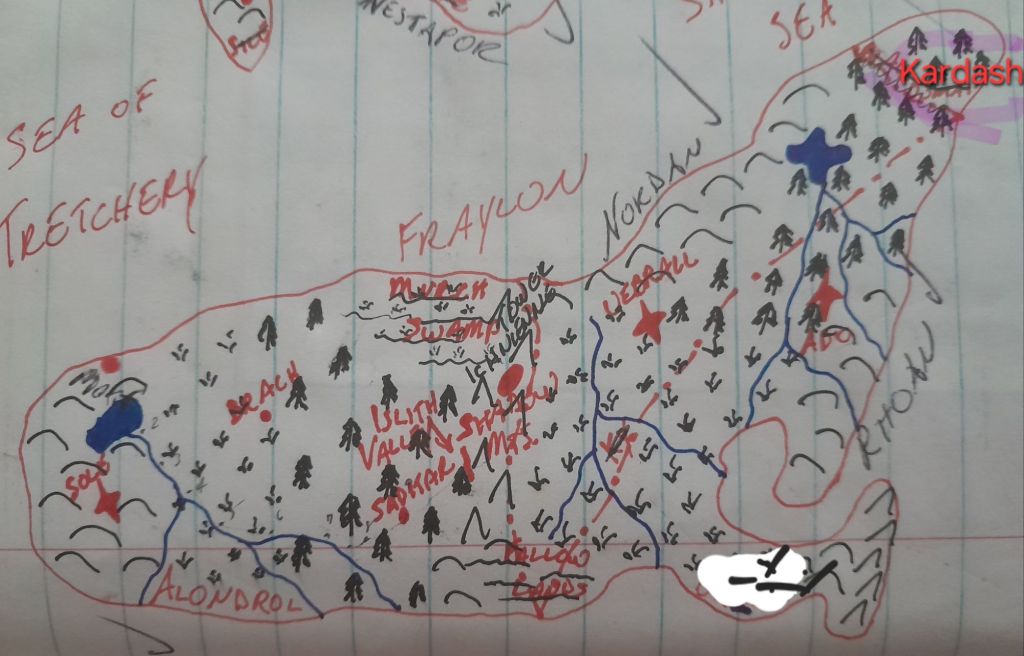
was once the domain of a powerful witch. It is heavily populated with goblins and kobolds. The residents of the country are too busy trying to stay alive to concern themselves with little more than basic farming and hunting. There is no exporting and little importing. Some trade goes on between villages, but each small hamlet is relatively self-sufficient.
From a young age those who live in Kardash learn to fight and defend themselves. As a result, most either die young or become unparalleled warriors. They are skilled with bow and blade.
Due to the ravages of the monster kind, there is no capital city. The citizens govern themselves with local magistrates, mayors, and militias. Despite the hardships, the population is on the rise and the monsters are slowly being brought to heel.
Surrounded on three sides by water, the seaside villages have swelled to the size of towns and even small cities. They are able to defend better and support the population. Sometimes they trade with the villages in the forest, seafood for venison.
It is considered the least developed country in all Terra, in most respects.
is the second largest exporter of lumber in all Terra. Aside from the Duran Hills and Arising Lake, the country is covered in both deciduous and coniferous trees. At one point in its distant past, the country had an entire forest of wandering willows that were cut down and used to build the temple to Lucian in the capital city of Lerball. It is the most grand and glorious temple to the god of Justice, and a pilgrimage site for the most devout followers. This brings the greatest revenue source to the country.
The country, a strongly Slavic-influenced culture, farms grains, cattle, and fruit trees. It also exports the exotic devora herring and fresh-water muscles from the Arising Lake. It heavily exports the rushing salmon that populate the upper expanses of the rivers.
The king and queen, who reside in separate palaces on opposite sides of Arising Lake, are often at war over who controls the country. Each has multiple lovers and bastard children, but no legitimate heirs with each other. As a result, the future of the country is always in question. This country’s intermittent civil war and persistent unrest makes it the second favorite country of the Shadow Council, as they often aide the side who pays better.
Despite the faithful journeying to the capital, the country is wholly unstable and rife with danger for its citizens. Local militias are the only way the inhabitants are able to defend themselves.
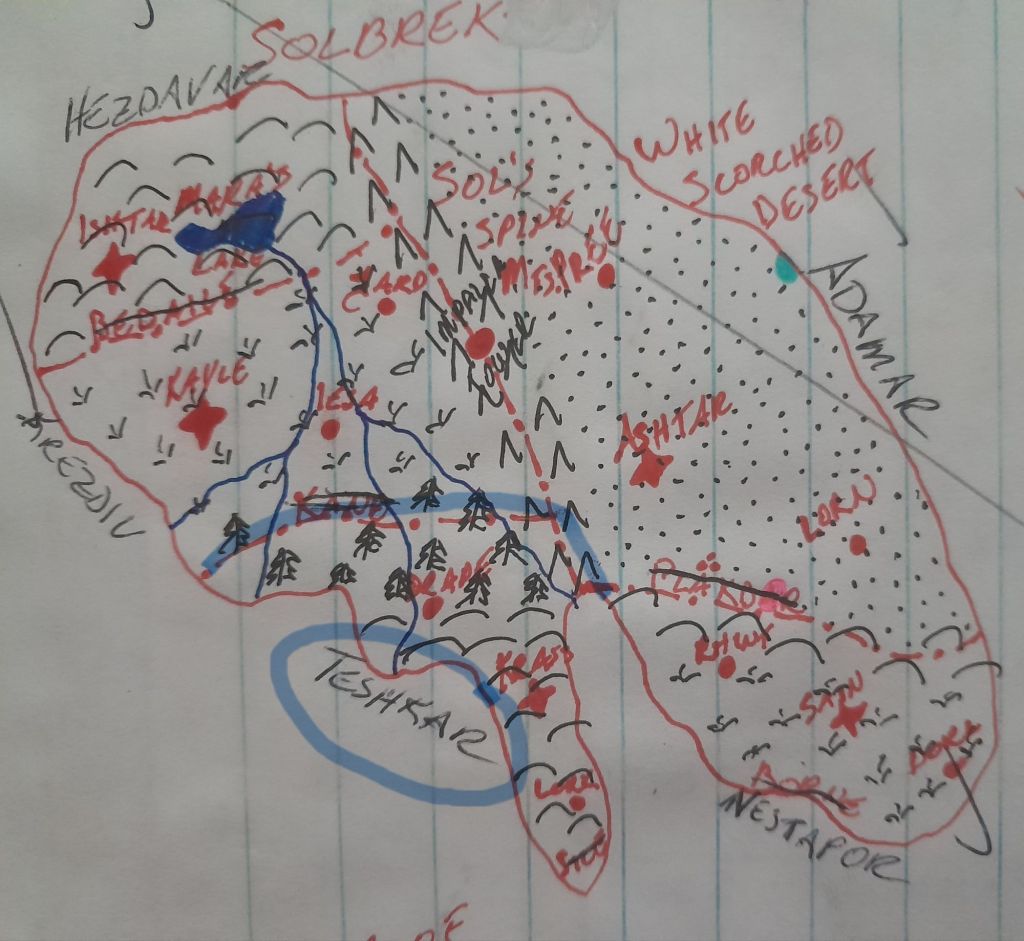
is the largest exporter of adamantine in all Terra. Most of those who reside along the western coast within the Cresting Hills and Twin peaks on the Tartan Peninsula work the mines that produce the exotic mineral. Across the Sundering Bay in the Dancing Hills are the most productive diamond, emerald, ruby, and sapphire mines in all Terra.
The northern and western branches of the Tetra River run through the southern part of the country providing a fair amount of freshwater fish. Naturally, the coastal region is flush with saltwater life providing sustenance and trade for those skilled enough to take advantage. Meanwhile, the Lancar and Brax Rivers offer different varieties of freshwater fish from the southern river. At the head of the bay, are gold, silver, and copper mines that are mostly exported.
The land around the rivers is lush and fertile, making for excellent farming of all kinds. The forests along the Cresting Hills is full of wild game. As a result, the country is relatively self-sustained. Their gem and mineral export makes them the wealthiest country. However, it has been in the midst of a civil war for many generations. The current rulers are at war with the heirs of the previous rulers. This has led to economic instability.
Quite frequently, the Shadow Council can be seen fighting for one side or the other. As a powerful mercenary band, they make most of their money off this conflict.
home of Princess Anya Sophia Kofski, heavily influenced by Russian culture. It is a large country and vastly grasslands and forest with the Shadow Mountains on its northeastern border with Nordan. The Trident River flows out from Shimmergloom Lake, providing access to the exotic and rare titan-head trout, which is found solely in its dark and sparkling, purple-blue waters. Between the fish and the unusual aquatic plant life the lake acquired its name.
Islith Valley, located between Tilda Forest and Shadow Mountains, is home to an extremely skilled and secretive clan of warriors. It is also the home to the most sought-after hot springs on Fraylon. One cannot enter the Valley without first challenging, and defeating, its champion in single combat.
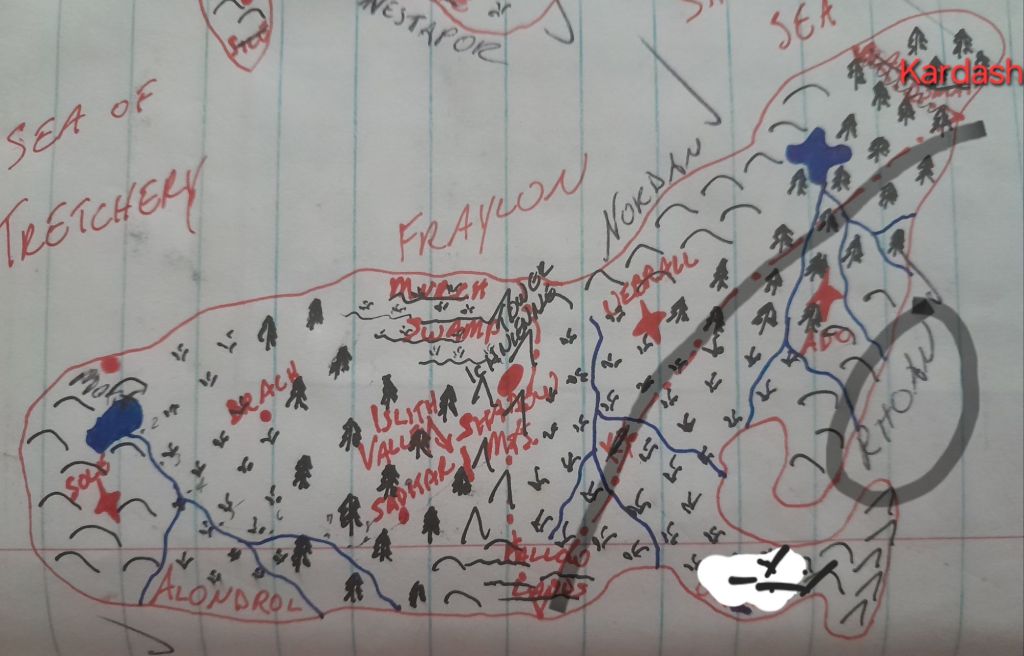
At the eastern-most corner of the country, is the once-most-fertile farmlands in all Terra. However, because the expanse is shared by the three largest countries on the continent, it was ultimately trampled to ruin.
The grasslands and southwestern hills are home to the farmlands that provide enough food for the country to allow them to export a significant amount of the crops every year. Not only are there cow, sheep, and pig farms, but alpacas are also a significant staple. Orchards and grains provide the remainder of the crops in the west while produce and cocoa are the staples of the east. The coastal fishing and deep diving provide a wide variety of fresh seafood for its own use as well as export.
While not home to any prominent schools of education, its citizens are intelligent and well-informed. Its military is more heavily infantry with light cavalry and their navy is a fraction of the size of Iskenderun’s or Nestapor’s. As for its information network, it still needs a significant amount of work before it will rival even Krezdiv’s.
is a Turkish-like culture in a hilly country with a vast lake which is the main source of their export since the aquatic life is unlike anything else in all Terra. The hill-country is also conducive to raising powerful and skilled horses and war elephants. While it’s not probable to export the war elephants overseas, it is possible to export them to anywhere on Solbrek. The war elephants have not been in high demand of late, though Teshkar acquired nearly a hundred of the beasts during their near civil war nearly two decades prior to the start of the series.
This country prizes beauty, grace, and strength above all else. Their nobility are almost exclusively housed in the capital city of Ishtar. Only a few live in sprawling and expansive compounds surrounding Lake Izarashi. None live out in the countryside. Incest is not uncommon among the nobility, to “keep the bloodlines pure” and also to maintain a specific level of beauty and desirability.
The singularly unique hammer-head salmon reside only in Lake Izarashi. Commonly used for scrimshaw as well as its buttery-sweet flesh, this is the biggest export product in the country. The northern corner of the country is renown for its exotic and rare spices. The combination of winds from the ocean and mountains, added to the fertile soil is ideal for the other famous income of the country. Between the fish, spices, and the breeding stallions, the nobles continue to assert their power. Slavery is also legal, acceptable, and a regular occurrence throughout the kingdom. Farming of all kinds provides the kingdom with nearly all the sustenance for the inhabitants. Fishing, within the lake as well as on the ocean, provides for the people as well.
While there are no academies or Titans’ Guard citadels, Hezdavar puts out many of Terra’s great warriors and mages who participate in the Corelon Zepheroth. Not to mention, the palace guards are among the most feared in Terra. They spend their lives, from age five, learning combat in all its myriad forms. Nearly all the royal guards are nobility in one form or another.
Two of the spices grown are also used for dyes. One creates a stunning yellow-orange while the other creates a unique bluish-purple. They are most often used to dye silks and pure cottons. These can be exported on their own as raw products, as well as in any stage of the product. They are the second largest export for the country and closely regulated by the nobility because they consider the colors exclusive for the extremely wealthy.
is a matriarchal society that is often overlooked or looked down upon. They have no real navy, but a strong army and cavalry. It is a country of mostly hills and forests with only a little farmland along the three rivers that cut through its terrain. Teshkar could be considered a Spanish-like culture. It is a relatively self-sufficient society and often misunderstood or simply neglected by the neighboring countries.
Maas Zupkas of Iskenderun is the only regular entity the queendom of Teshkar trades with. Their relationship dates back several decades and therefore affords Iskenderun, and more specifically the capital city of Debash free access to rare and exotic items not found anywhere else on Terra. It is a little-known fact, even to his son Varkas, that the late Lady Zupkas was a Teshkaran noblewoman. As a result, Teshkar has access to many commodities from Iskenderun they would otherwise not even be aware of.
Despite all this, the distrust of most other nations, the self-sufficiency, and the strong ground military, Teshkar is a nation that loves, admires, and appreciates the arts. All citizens are required to serve a minimum of three years in the Teshkaran military. Many stay and make it a career, while many others seek out different professions. While not known throughout Terra, smiths of every kind are incredibly skilled. Farmers and herders are capable of defending their homes and lands. The capital is not a large city, by the standards of most other nations, but is considered well-developed.
Slavery is legal but uncommon. The capital is the only large city, by national standard. Villages look out for one another and trade readily and frequently. Many children receive their education at home, rather than in a formal school setting, though they do exist. Beyond basic reading, writing, and math, children learn in common as well. Most are introduced to a trade before joining the military.
Marriage and divorce are both normal and socially acceptable. While men have nearly equal rights, it is usually the woman who decides how children are raised, how finances are handled, and who will lead in the village. Women often select their mates, rather than the other way around. They also, regularly, end the relationships as well. Women have the final say on legal matters.
where the bulk of the book begins, is the largest country in all Acleron. It is a European-like nation ruled by a monarchy. It has been under the sovereign reign of the Whitehart family for nearly twenty generations.
The northern part of the country is known for its coffee and chocolate. The western part of the country is known for its lumber and wood-based products. The eastern part of the country is known for its fresh-water fish and produce. The southern part of the country is known for its horses and dairy.
While the country is currently at war with the monster hordes descending from the north, the commerce has come to an almost complete halt. The refugees fleeing the war are flooding the capital. Those who can’t find work or lodging there continue south, many have take up residene in Karnak.
King Darius Whitehart is the current ruler of the nation. He is succeeded by two children, Prince Gordon and Princess Isadora. As the war progresses, the royal children become more involved in the future of not only their nation, but all of Terra.
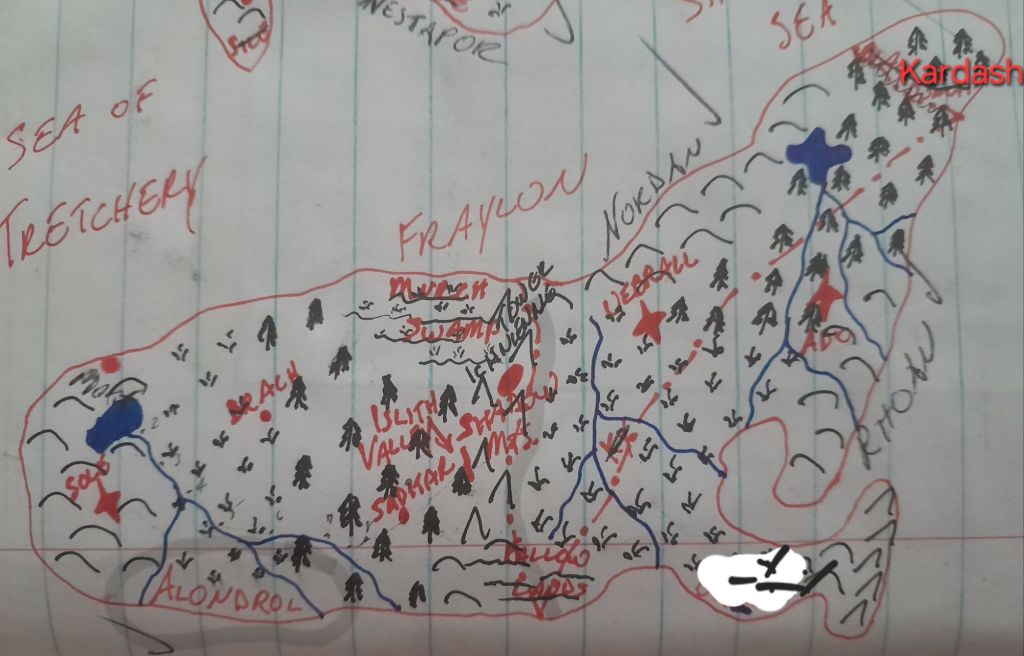
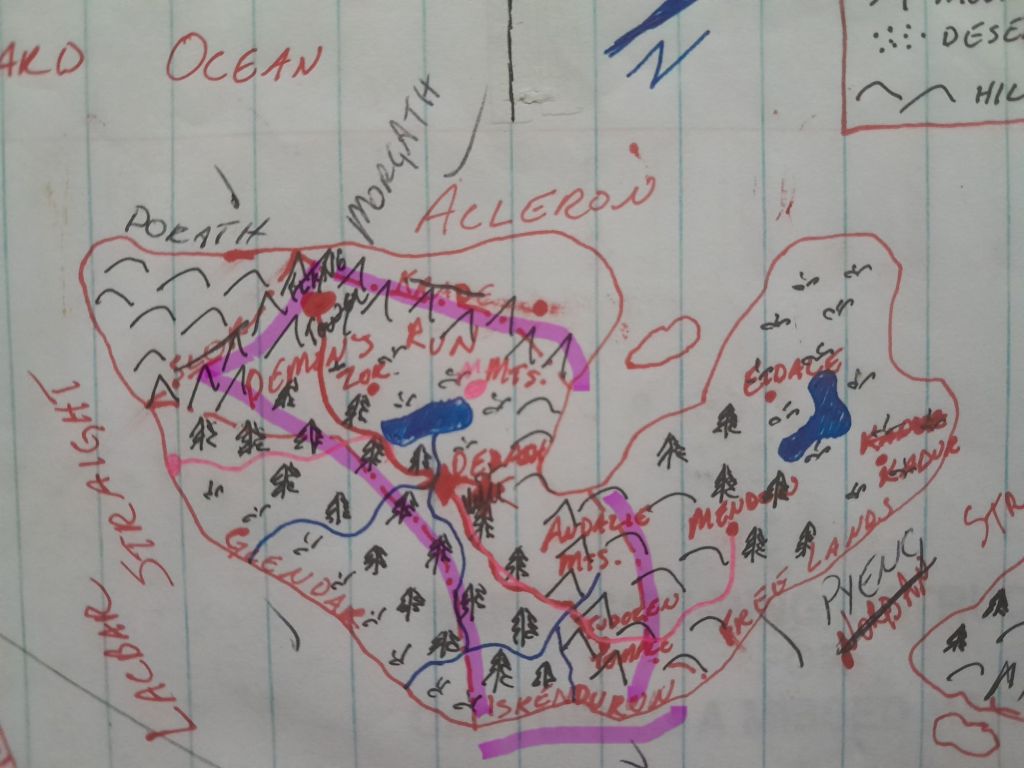
Iskenderun is considered to be the third most developed, human country in all Terra. It comes behind Cynsely and Krezdiv in advancement and overall prosperity. Their water and waste systems are fashioned after the two countries’. The justice system is second to none. Their military and navy are only superceded by Cynsile (for their navy) and Alondrol (for their army in sheer numbers). They trade with every country on Terra, every good and/or service except slaves.
The major holidays celebrated in Iskenderun are the midwinter festival (the most popular), followed by the midsummer festival (when the royal tournament is held), with the midautumn and midspring celebrated with equal fanfare. Though, after Ally’s Deceit they will celebrate the midspring festival as that is when the prince and princess were wed.
Blythe Evenstar and Meithose Dragonslore hail from the Andalie Mountains on the northeastern border shared with the Free Lands. The royal children hail from Debash, the capital. Lirin Vibert and Jamien Weaver originally hail from villages in southern Iskenderun near the border with Glendar, as does Sevelin Dragonslore. Even Hajib Khalal hails from Karnak, the great port city on the southern coast.
vary through the countries and cultures across Terra.
Cynsely, home of the medical academy, leads Terra in all things related to the health and well-being of its citizens. This country has the most advanced water system both supplying and waste-water treatment. Their waste disposal and postmortem protocols are mimicked by many of the other countries.
Iskenderun is close behind along with Glendar, Krezdiv, and Ni-Shan. All four countries boast water and waste systems similar to the democratic island nation, with slight variations.
Rhoan and Kardash are the least developed countries in Terra. They sustained devastating losses after the mysterious fever that swept across the world. As a result, they struggle to maintain many basic necessities.
The remainder of the countries of Terra fall somewhere between the two groups. They aren’t as advanced for one reason or another. Though *spoiler* with Princess Isadora married to Prince Glaive, Nestapor is expected to join, if not surpass Iskenderun, in all areas. And with Teshkar, Adamar, and Hezdavar bordering on Krezdiv, they are poised to make monumental improvements in the near future.
*SPOILER ALERT*
Morgath, recently emancipated from the bloodmage and his monstrous hordes, is in a shambles. Therefore, its infrastructure, economy, and people are in disarray. It will take many decades to recover.
tend to be nearly as extravagant as the midwinter festivities. Many countries host tournaments as part of their celebration. They also, occasionally, host bardic competitions.
The festivities last for the better part of the week. There’s always the early harvest available and the finished products from the spring fiber collection.
As it is the longest day of the year, day-drinking is widely accepted. In Iskenderun, the dwarves come down from the mountains with their great casks of ale, spirits, and mead.
The most renown bardic contest is before the Corellon Zepheroth. It affords the victor all manner of riches and glory. The Zepheroth itself is the most famous tournament in all Terra with equal fame and fortune.
In Ni-Shan, as with the winter solstice, there are fireworks as part of the celebration. There are plays, puppet shows, and minstrel performances.
Many other countries celebrate in solemnity, instead. There is fasting and prayers.
are celebrated all across Terra. Though they are seldom as elaborate as the midwinter or midsummer celebrations.
There is always feasting, often provided by the temples of goodly deities for their parishioners, drinking, and dancing. Many couples choose to wed on and around the day.
Many wealthy households open their massive and elaborate gardens to the public. Some cities even have garden competitions. Those participants go to extensive lengths to have the best displays. Some even hire druids.
It is also the time of new life. Lambs, kids, foals, calves, puppies, kittens, and chicks fill the land. Fiber is collected: sheep, goats, rabbits, llamas, and alpacas are shorn for their fur and hair. Bamboo and cotton are also harvested and treated for their fiber. Villages depending on such things have great celebrations to dye and process the fiber at this time.


 The World of Terra